See the market the way dealers are forced to trade it.
JARVIS is two terminals in one seat, built for one market and one market only: NQ futures. Desk 1 computes dealer gamma from the options complex and sets the day's volatility ruler. Desk 2 reads the microstructure: order-flow imbalance, flow toxicity, end-of-day dealer and CTA flows. It runs on your machine, on your own live data. Together: you know when the tape should pin, and when it's allowed to run.
A TOOL, NOT ADVICE · NOT A BOT · NOT SIGNALS · CANCEL ANYTIME · 7-DAY REFUND
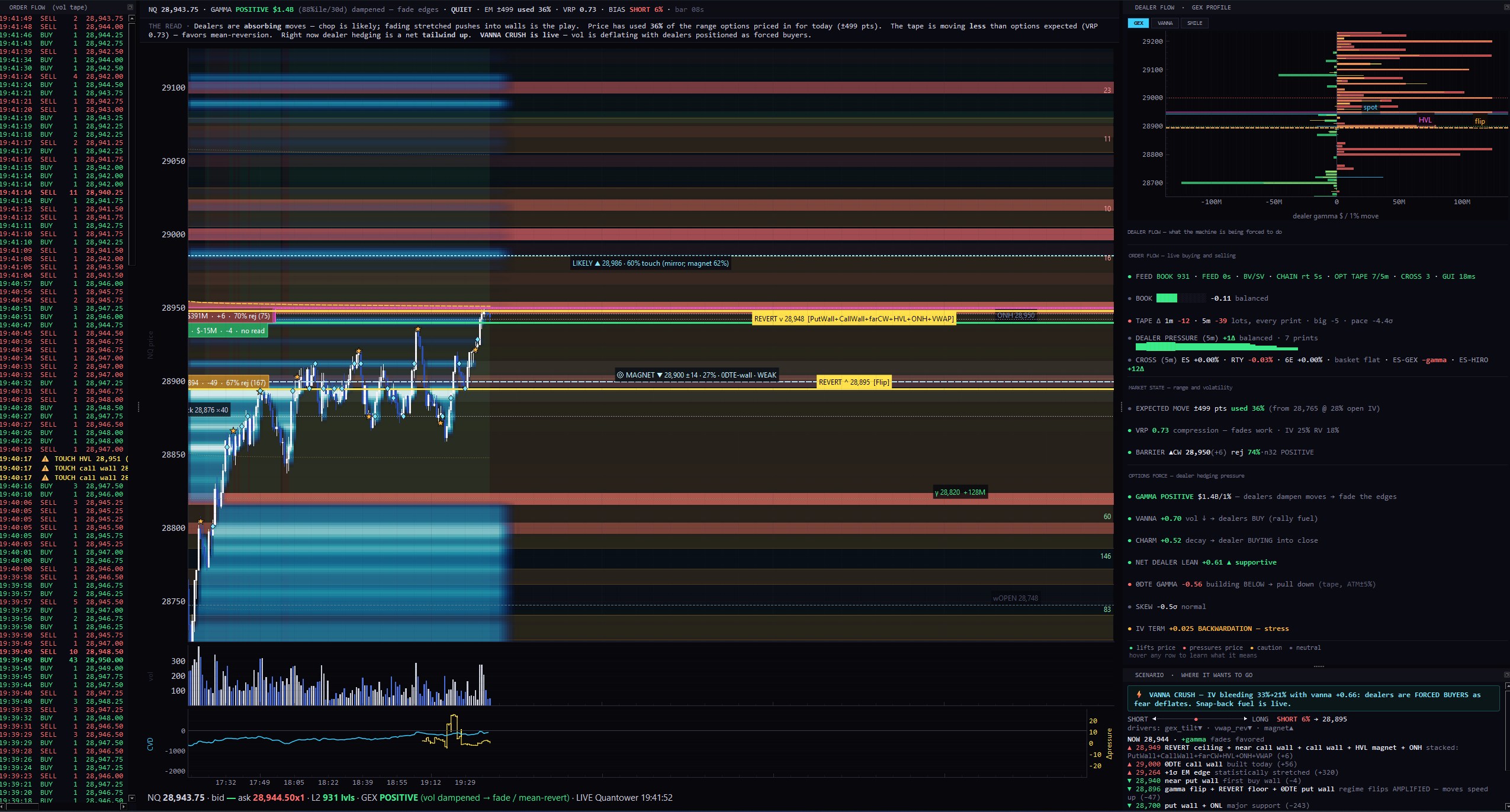
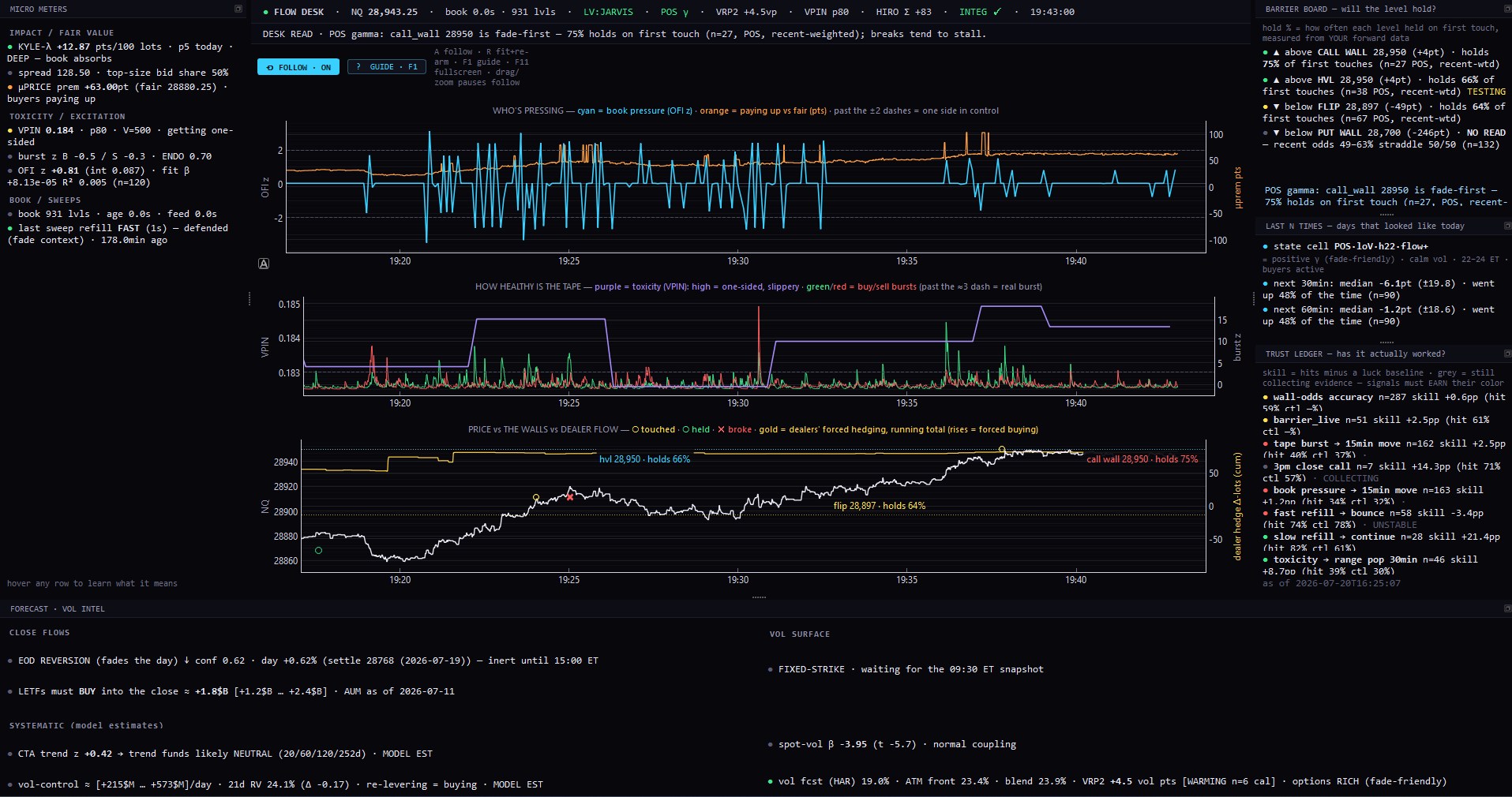
Two desks. Eight modules. One read of the tape.
Dealer gamma map
SIGNED $GAMMA · PER STRIKE · LIVE
Per-strike signed dollar gamma computed live from the options complex, scaled to NQ. Call and put walls, the near-field walls that actually matter intraday, the HVL pin, and the gamma flip. The regime is called POSITIVE or NEGATIVE outright, not implied.
Volatility ruler
ATM IV · EXPECTED MOVE · VRP
ATM IV distilled into a live 20-minute expected-move band, plus VRP (realized over implied), the desk's central regime tell. Expansion tape rides breakouts; quiet tape gets faded. The terminal says which one you're in.
Order-flow suite
CVD · SWEEPS · SMT vs ES
CVD, absorption, sweep detection, book imbalance, liquidity-pool magnets, and SMT divergence against ES, fused into one signed bias score whose components flip sign with the gamma regime, because the same flow means different things in different regimes.
Magnet engine
FUSED LEVELS · STATED CONFIDENCE
Every level the data cares about (pins, shelves, session references, volume walls) is scored and fused into a single destination band with a confidence number. Not a point target. A band, with its confidence stated.
Microstructure suite
CONT OFI · KYLE λ · VPIN · HAWKES
Order-flow imbalance, microprice lean, Kyle-lambda price impact, VPIN flow toxicity, Hawkes self-excitation, and book-refill ratios: the professional microstructure stack, computed live and labeled in plain language.
EOD flow engine
GAMMA HEDGE · LETF · CTA · VOL-CTL
Who has to trade into the close, and how much: dealer gamma hedging, leveraged-ETF rebalance, CTA trend triggers, and vol-control supply. Estimated in dollars, signed buy or sell, summed into one net number.
Barrier engine & level scorecard
FORWARD ODDS · SAMPLE SIZES SHOWN
Every wall touch is logged and resolved: rejected or broken. Each barrier shows a live state (HOLDING, ERODING, BROKEN) plus its measured consistency against the scorecard, so "strong level" is a number with an n attached, not a feeling.
The honesty layer
MIRROR CONTROLS · UNTRUSTED BADGES
Every predictive signal is graded forward against a mirror control. When a signal's skill goes negative, the terminal badges it UNTRUSTED right on the panel. You will never be shown a number the desk itself doesn't believe.
This is the actual software. Not a mockup.
Below are real captures of both desks from a live session. Flip between them with the switcher. A seat gets this exact software running on your machine, on your own live data.
Signals that grade themselves and admit when they're wrong.
Most retail tools show you a signal and let you assume it works. JARVIS ships with a scoring layer that grades its own output forward against controls. When a signal's measured skill goes negative, the terminal badges it ⚠ UNTRUSTED right where you'd read it. That badge is the feature.
Measured on decided touches only: every wall touch is logged, then resolved as a rejection or a break. No cherry-picking, no timeouts counted as wins.
Each magnet prediction is scored against a mirror level at equal opposite distance. Skill = hit rate minus control. If the desk can't beat a coin flip, it says so on the panel.
There is no historical options data good enough to backtest this honestly, so we don't pretend. Everything is measured forward, in production, and the numbers update as the sample grows.
Reject rates are per-level, per-regime, shown with sample sizes in the terminal. Past measurements do not predict future performance.
Runs where a terminal should: on your machine.
Your machine
Both desks install and run locally, like a professional terminal should. Your ledgers, your state, your screen layout. Nothing about your trading leaves your box.
Your data
Live CME futures and options flow through your own subscription, connected in minutes through the free Quantower platform. Licensed to you, in your name, exactly how a desk would do it.
Your seat
Your email is the license. The app verifies your seat, keeps itself updated, and every improvement we ship lands in your terminal. Cancel and it stops; that's the whole contract.
ONE SEAT, EVERY FUTURE UPDATE INCLUDED. NO TIERS, NO ADD-ONS.
One plan. Both desks.
No tiers, no locked panels, no "pro" upsell. A seat is both terminals, live during market hours, for less than a single tick of slippage on one NQ contract per day.
NQ ONLY · BILLED MONTHLY VIA STRIPE · CANCEL IN TWO CLICKS FROM YOUR RECEIPT · 7-DAY REFUND ON YOUR FIRST PAYMENT · NO CARD DETAILS EVER TOUCH OUR SERVERS
NQ FUTURES ONLY. ONE MARKET, COVERED PROPERLY.
- +Both terminals: JARVIS 1 (gamma desk) + JARVIS 2 (flow desk)
- +Live dealer-gamma map with walls, flip, HVL and regime
- +Volatility ruler: ATM IV, expected-move bands, VRP regime
- +Order-flow suite: CVD, sweeps, absorption, book imbalance, SMT
- +Microstructure stack: OFI, microprice, Kyle-λ, VPIN, Hawkes
- +EOD flow engine: dealer gamma, LETF, CTA and vol-control $ into the close
- +Magnet band, barrier engine, and level scorecard with sample sizes
- +Every signal forward-graded, UNTRUSTED badges included
A tool, not financial advice. Futures involve substantial risk of loss. Not for you? Full refund within 7 days of your first payment. Market data sold separately by your data provider (typically $30–60/mo).
Asked before you had to.
Is this a bot or a signal service?+
Neither. JARVIS never places trades and never tells you to. It's a reading instrument: dealer positioning, volatility regime, and order flow, computed live and put on one screen. What you do with the read is your trading.
What's the difference between JARVIS 1 and JARVIS 2?+
One seat, two desks, one click apart. JARVIS 1 is the gamma desk: dealer positioning by strike, walls, volatility ruler, magnet, and the fused market bias. JARVIS 2 is the flow desk: microstructure (OFI, microprice, Kyle-lambda, VPIN, Hawkes), the end-of-day flow engine that estimates who must trade into the close, vol-surface reads, and the barrier engine.
What do I need to run it?+
A Windows PC, the free Quantower platform (our installer sets up the data bridge in it automatically), and your own live market data, typically $30-60/mo bought inside Quantower in about five minutes. The setup checklist in the app walks you through every step and checks itself off as things come online. Zero coding, zero config files. Already trade through a prop firm? Your existing feed powers the order-flow side out of the box.
Why do I buy market data separately?+
Exchanges license live data per person, so your feed has to be in your name. You buy it once, directly from the data provider, inside Quantower. It's your account and your card; JARVIS never touches either, and your market data never leaves your machine. This is the same model used by every serious trading platform.
Which markets and hours?+
NQ only. Both desks cover Nasdaq-100 futures and the options complex it trades against, and nothing else. No ES, no equities, no crypto. Depth over breadth is the whole point. The desk runs during US market hours; overnight the terminal shows the last state and session references.
Why should I believe the numbers?+
Because the terminal is built to distrust itself. Predictive components are graded forward against mirror controls, level statistics show their sample sizes, and anything with negative measured skill wears an UNTRUSTED badge on the panel. We publish the grading method, not just the output.
How does sign-in work?+
Inside the app, with no passwords. Enter the email you used at checkout (the one on your Stripe receipt) and JARVIS emails you a 6-digit code; the app stays signed in for 30 days. Your subscription status in Stripe is the only account record that exists, and we never see or store your card. Code not arriving? Check spam and make sure you're using your checkout email.
Can I cancel? Can I get a refund?+
Cancel anytime, in two clicks, from the Stripe portal linked in every receipt; access runs to the end of the paid period. And if JARVIS isn't for you, email us within 7 days of your first payment and it's refunded in full, no questions asked. After 7 days, and for renewals, payments are non-refundable.
Is this financial advice?+
No. JARVIS provides market analytics for informational purposes only. Futures trading involves substantial risk of loss and is not suitable for every investor. Nothing on this site or in the terminal is a recommendation to buy or sell any instrument.